
Glass Partitions Acoustics: Quick Review
What is glass partition acoustics?
Acoustic glass solutions can be used to reduce noise transmission through the glass. Acoustic glass solutions absorb sound and reduce reverberation, allowing light to pass through.
The solutions can include laminated glass, curved glass, or even specially designed acoustic coatings. Additionally, acoustic seals can be installed around the edges of the glass panels to reduce sound transmission further.
What is the importance of acoustic glass partitions?
Productivity, well-being and happy employees are all critical considerations in the ideal office environment. So, where does the sound fit into it, and how does Glass Partitions Acoustics perform at its best?
Without a doubt, overlooking sound in a design can present lots of difficulties in the long term. High on the list of annoyances in the workplace, noise can change people’s behaviour and cause stress. With acoustic performance so essential, what steps can designers and specifiers take to create a quieter office environment while offering the right ambient noise and improved privacy?
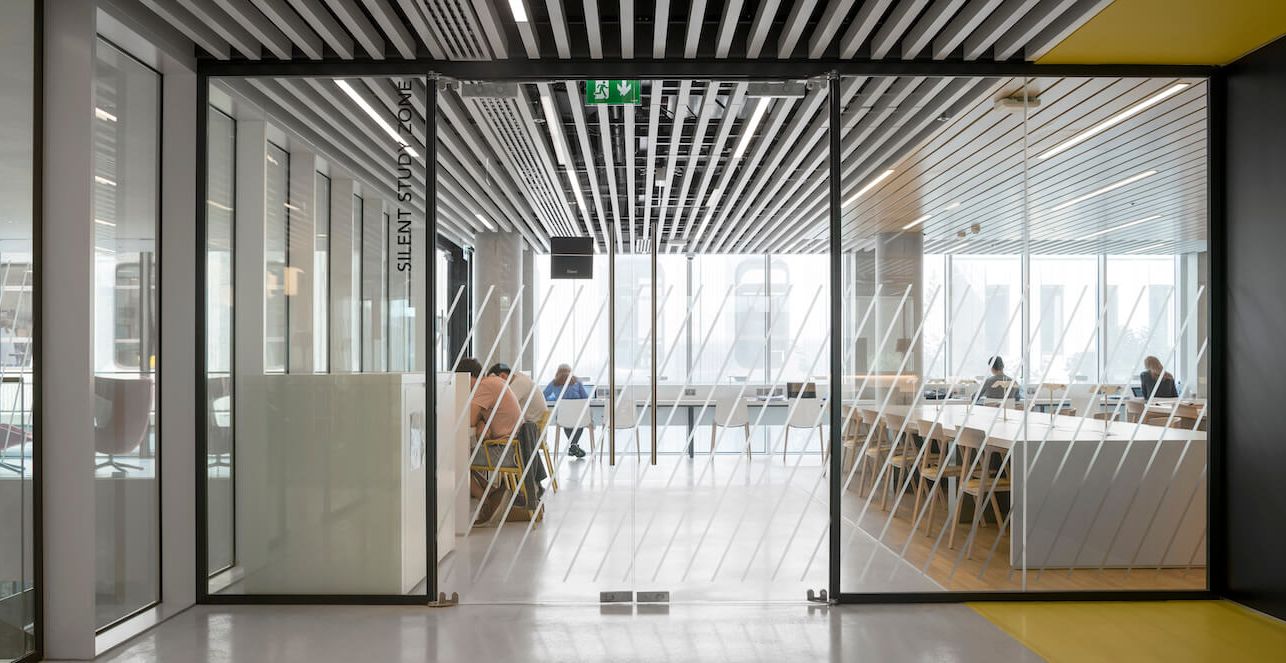
Glass Partitions Acoustics Performance and Design
The performance of Glass Partitions Acoustics in office fit-out projects has become a key priority. Like lighting, it should be an integral part of good architectural design. When done well, it’s a significant contributor to the well-being and productivity of the office employee. Interestingly, acoustic privacy and comfort levels are often worse if the background noise levels at workspaces are too quiet. This suggests striking a balance between noise and silence is critical to designing a thriving work environment.
From the outset, it’s important to use materials which will achieve good acoustics and solve any sound transmission issues. The designer must also meet the client or end user’s requirements for privacy and reduced noise transfer between offices.
With informal, open-plan and flexible spaces replacing the past’s more formal, enclosed and private rooms, the office has seen significant changes in recent years. Unfortunately, this flexible work ends up having a knock-on effect. Occupation levels increase, offices are noisier, and productivity hinders. There is, however, a growing need for quiet rooms and meeting rooms where confidential conversations can take place. This is why the acoustic effectiveness of glass partitions has become a critical factor in noise reduction.
Proven Expertise: 4-6-8 Pembroke Lane Case Study
When it comes to acoustic performance, seeing the results in action speaks volumes. Our project at 4-6-8 Pembroke Lane is a strong example of how expertly designed glass partitions can transform an office environment, delivering both form and function without compromise.
Key Outcomes:
- Precision Acoustic Performance: We specified and installed high-performance glass systems with tailored acoustic seals, ensuring optimal sound insulation for private meeting spaces.
- Design-Led Solutions: The project retained an open, contemporary aesthetic while achieving the levels of acoustic control essential for a productive and focused workspace.
- Client-Centric Approach: By closely aligning with the client’s needs, we delivered a workspace that balances transparency with privacy, supporting both collaborative and confidential work.
Explore how we helped bring acoustic clarity and design integrity to this flagship office space.
How to Manage the Noise with Glass Partitions Acoustics
We need to look at both keeping the noise out and keeping the noise in. In other words, we must prevent noise from entering a busy circulation space into a private office. At the same time, we must prevent privacy loss from the office to the external space.
The Glass Partitions Acoustics effectiveness is also known as the sound insulation or sound reduction performance and is measured by the sound reduction index (SRI). This is the ability of a partition to reduce the level of sound passing through it. You can measure the SRI by testing a partition sample in an acoustic laboratory following EN ISO 10140-1 and 2. You then express the result in dB (Rw) under EN ISO 717-1; this allows specifiers to compare similar partitions.
Furthermore, it’s also essential to consider the acoustic performance of doors and ensure that the acoustic seals are efficient when fitting. Flanking sounds through floor or ceiling voids are another factor and can occur if partitions do not extend to the floor slab above or if ceiling void acoustic barriers have been installed but have not been correctly sealed around service penetrations.
Acoustic terminology can be confusing, with technical terms and specialist jargon. However, acoustic design has never been more critical when it comes to the design of offices. Achieving good Glass Partitions Acoustics standards and solving sound-transmission issues requires the same level of attention as other design elements.
Find out more about managing noise, what performance you need and how to make sure you deliver on-site with our RIBA/RIAI Certified CPD seminar, “Understanding Partition Acoustics”.
Frequently Asked Questions
Glass partition acoustics refer to the use of specially designed glass and accessories to reduce sound transmission through glass partitions in spaces like offices. This helps control noise while still allowing light to flow freely.
Noise is a major source of distraction and stress in modern workplaces. Acoustic glass partitions help maintain a quieter, more private, and productive environment, which contributes to employee well-being and overall office efficiency.
When creating our designs for our clients, we always choose appropriate materials, ensure proper acoustic sealing, and address potential flanking paths (e.g., through ceilings or floors) to maintain high acoustic performance.
Yes. In open-plan spaces, acoustic glass helps create quiet zones and meeting rooms where confidential conversations can take place, balancing openness with the need for privacy and reduced noise.
Let's continue the conversation
Get in touch and schedule a consultation with our frontline specialists
Take me there